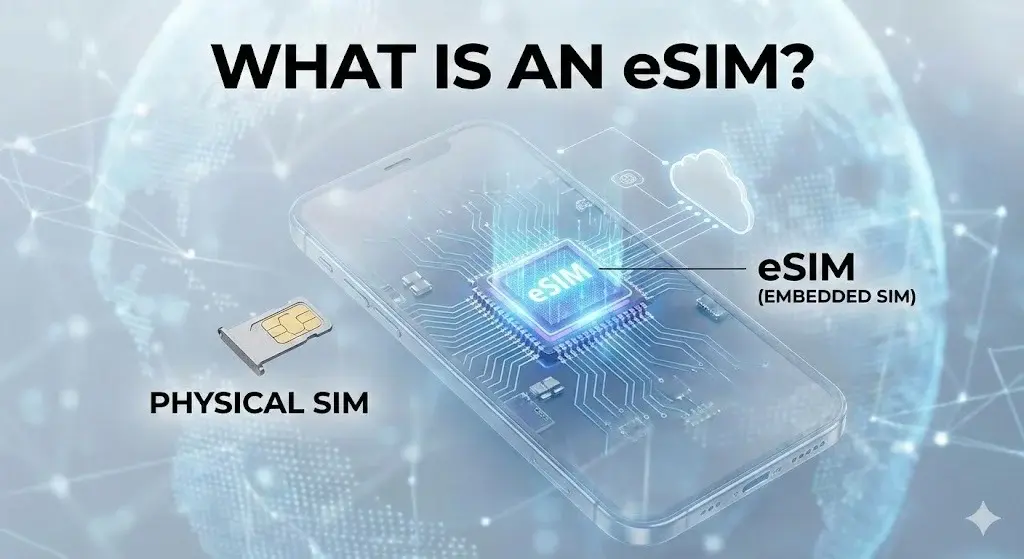
What is an eSim?
An eSIM (embedded SIM) is a digital SIM chip built directly into your device’s motherboard, eliminating the need for a physical SIM card. It uses the eUICC (embedded Universal Integrated Circuit Card) standard, allowing your phone to download and manage mobile network profiles over the air via QR code or carrier software. eSIM technology has been supported on most flagship devices since 2018.
| Feature | eSIM | Physical SIM |
|---|---|---|
| Form Factor | Built into motherboard | Removable plastic card |
| Activation | QR code or app download | Insert card into tray |
| Carrier Switching | Remote, instant | Physical swap required |
How Does eSIM Work?
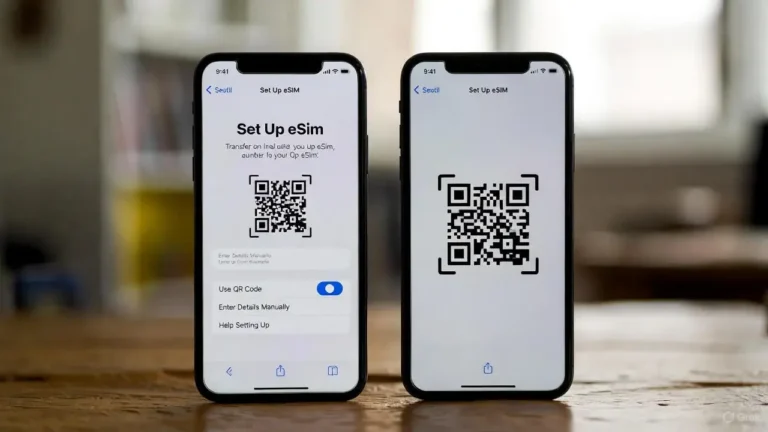
The eSIM chip stores carrier profiles digitally on a rewritable chip inside your phone. When you activate a plan, the carrier’s profile is downloaded via Remote SIM Provisioning (RSP), which securely connects your device to the network using protocols defined by GSMA. Users scan a QR code or download carrier software directly to load network credentials.
- Multiple profiles: One eSIM can hold several carrier plans simultaneously
- Profile management: Switch carriers through device settings, no card swap needed
- Instant activation: Download a plan in minutes, even before landing in a new country
Which Devices Support eSIM?
Most flagship smartphones released after 2018 support eSIM, provided they are not SIM-locked. Beyond phones, eSIM works with:
- Smartwatches (Apple Watch, Samsung Galaxy Watch)
- Tablets (iPad Pro, iPad Air)
- Wearables and IoT devices (drones, trackers, connected cars)
Apple’s iPhone 14 and later (US models) are eSIM-only, with no physical SIM tray.
Can eSIM Hold Multiple Plans?
Yes. An eSIM can store 8 or more carrier profiles on one device, though only one or two can be active at a time depending on the phone. This enables:
- Dual SIM setups: Keep a personal and work number on one phone
- Travel flexibility: Add a local data plan without removing your home SIM
- Carrier testing: Try different providers before committing
Does eSIM Work with 5G Networks?
eSIM is fully compatible with 5G networks. Major carriers worldwide, including networks like Docomo (Japan), Three (UK), and T-Mobile (US), offer 5G eSIM plans. The eSIM chip itself does not limit network speed; connection quality depends on the carrier and device modem.
What Are APN Settings and Tethering with eSIM?
APN (Access Point Name) settings configure how your device connects to the carrier’s data network. Most eSIM profiles auto-configure APN settings during activation. If manual setup is required, settings are typically provided by the carrier via email or app.
Tethering (hotspot): eSIM plans support tethering unless restricted by the carrier’s policy. Travel eSIM providers like Holafly, Airalo, and Orbitmobile often allow unlimited or high-cap tethering for sharing data across multiple devices.
Do I Need a Phone Number with eSIM?
Not always. Data-only eSIMs provide internet access without a voice number, ideal for travelers who use apps like WhatsApp or Zoom for calls. Voice-enabled eSIMs assign a local or international phone number for calls and SMS.
- Data-only plans: Lower cost, no number
- Voice + data plans: Local number included, higher price

Tasnima Tabassum Ema is the Founder and Lead Data Analyst at eSIM Expart. Driven by her own costly roaming nightmares, she built the site to save fellow travelers money. She specializes in rigorous, real-world testing and calculating the true cost per Gigabyte ($/GB) to ensure you always get the cheapest, most reliable connection.
One Comment